Things we've built

We build real platforms for real businesses — not just brochure sites.

GovTech · Bid Writing · AI

HelpMeBid.co.uk — Social value bid writing, made manageable

HelpMeBid helps small and medium UK businesses respond to social value requirements in public sector tenders — one of the most consistently confusing and time-consuming parts of bidding for council, NHS, and government contracts. We built the platform end to end.
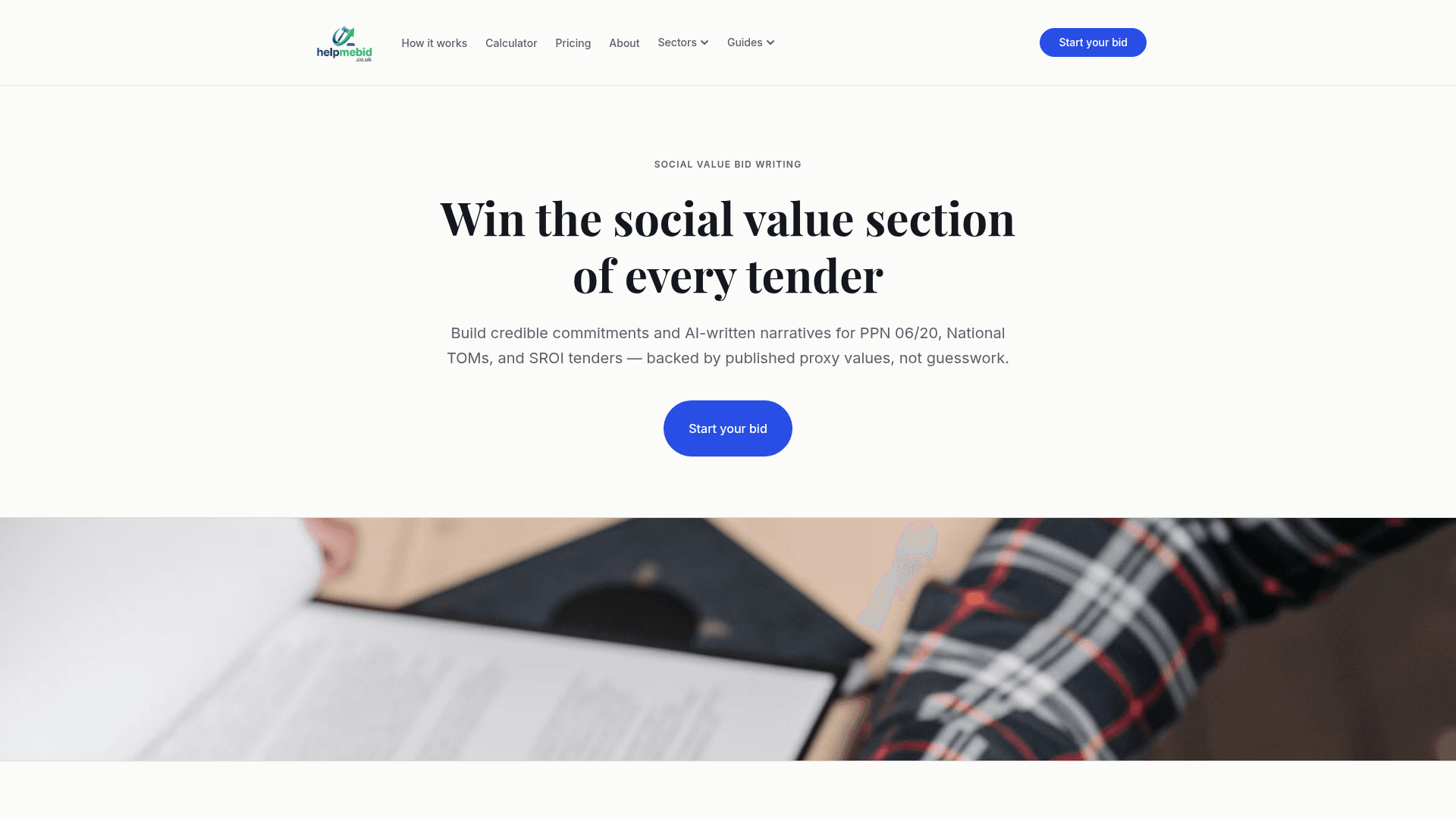
HelpMeBid.co.uk website screenshot

Visit helpmebid.co.uk

Who it's for

SMEs and bid managers in construction, facilities management, and care — sectors where public sector contracts are common, but where most businesses don't have a dedicated bid-writing team. HelpMeBid is built for someone who knows their business well but doesn't have time to become an expert in social value scoring frameworks for every tender.

The problem

UK public sector tenders increasingly score bids on “social value” — community benefit, local employment, environmental impact — measured against a standardised framework (the National TOMs). Working out what to commit to, how to phrase it convincingly, and how to avoid inventing numbers that don't hold up is a genuine skill gap for most SMEs, and one that's expensive to outsource to a bid consultant for every single tender.

What we built

  • Opportunity feedPulling live tenders from multiple public sources (including Contracts Finder and Find a Tender), so users see relevant opportunities without manually searching multiple government portals.

  • ITT import and AI extraction pipelineUsers upload a tender document and the system extracts the actual requirements automatically, instead of someone manually re-reading a 40-page PDF.

  • National TOMs-based commitment builderAdjustable sliders for social return on investment (SROI), so users can build realistic, scoring-aligned commitments rather than guessing.

  • AI narrative generatorWrites the bid response text — built with a token-substitution approach specifically designed to stop the AI from inventing figures or claims that aren’t backed by the user’s real commitments.

  • Pay-per-bid model£45 per bid, no subscription, with Stripe-powered payment — so smaller businesses can use it without committing to a monthly cost for something they might use a handful of times a year.

Why this approach

Most tools in this space are either expensive bid-consultancy retainers or generic AI writing tools that don't understand the specific scoring framework councils actually use. HelpMeBid sits in between — affordable, framework-aware, and built to stop AI hallucination from creating compliance risk in a process where inaccurate claims can actually disqualify a bid.

This is the kind of focused, purpose-built platform we enjoy building — solving a real, specific problem for a specific industry, not just shipping a generic template with a new logo.
HealthTech · Insurance · Comparison

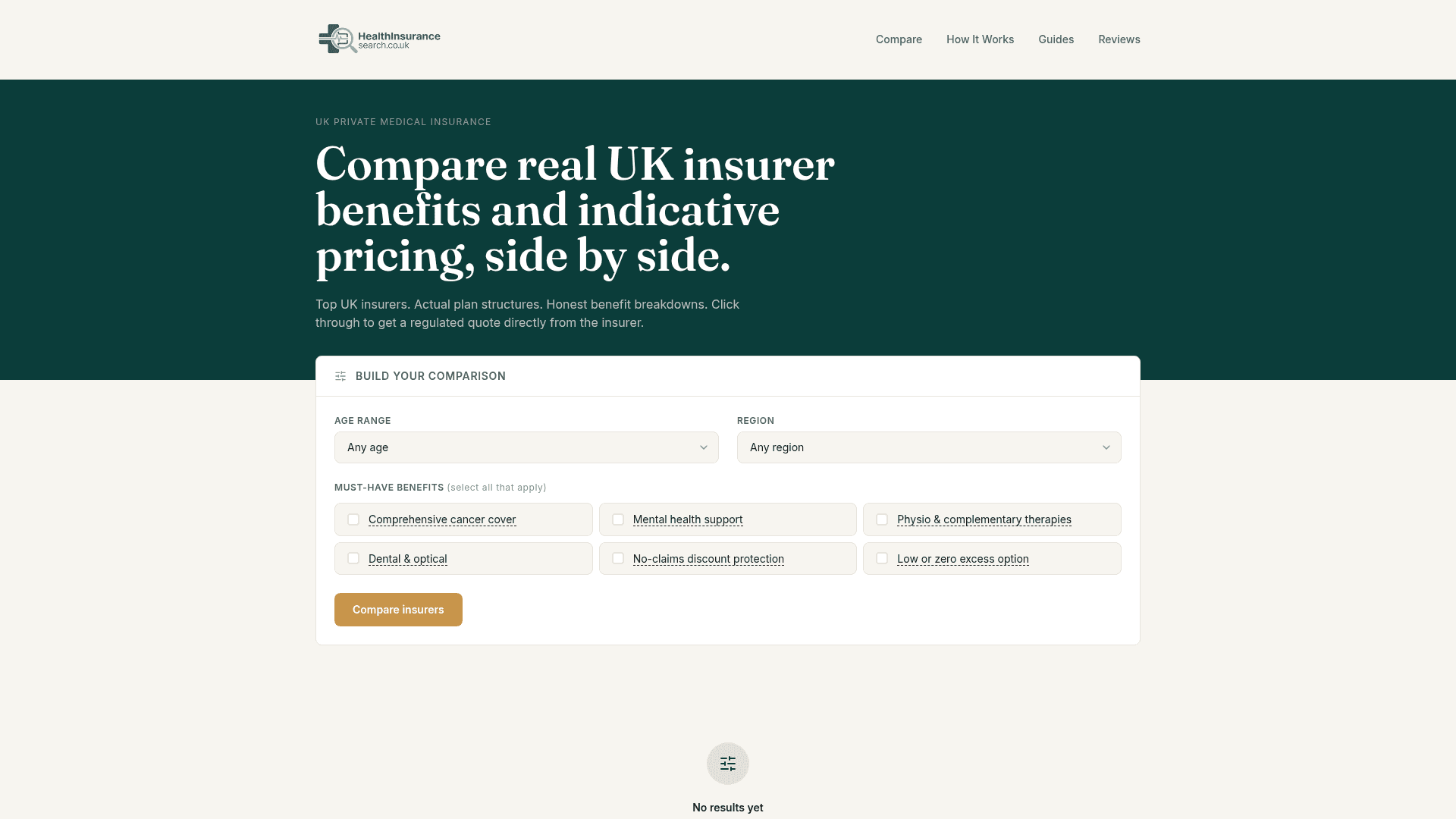
HealthInsuranceSearch.co.uk — UK private medical insurance, compared properly

HealthInsuranceSearch is a UK PMI (private medical insurance) comparison platform built to help people make sense of a genuinely confusing market — comparing prices, benefits, and policy details across the UK's leading health insurers before clicking through to get a real quote. We built the full platform end to end, from data architecture through to content, commercial structure, and regulatory positioning.

HealthInsuranceSearch.co.uk website screenshot

Visit healthinsurancesearch.co.uk

Who it's for

Anyone considering private health insurance in the UK — whether they're buying for the first time, switching insurer, or trying to understand whether a full PMI policy or a health cash plan better suits their situation. The site is particularly useful for people who've tried comparing insurers directly and found the benefit terminology impossible to compare like-for-like without a neutral reference point.

The problem

The UK PMI market is opaque by design. Insurers present benefits differently, use different terminology, and make it genuinely difficult to compare the same thing across providers. Most comparison tools in this space are either broker-owned (with obvious commercial bias toward whoever pays the highest commission) or so simplified they strip out the nuance that actually matters when choosing a policy — underwriting type, six-week wait options, mental health cover, hospital lists. The result is that most people either pick a name they recognise, ask a broker who earns from the recommendation, or give up.

What we built

  • Structured plan datasetcovering 12 PMI insurers and 26 individual plans — Bupa, AXA Health, Vitality, Aviva, WPA, The Exeter, Saga, Freedom Health Insurance, BHSF, Healthier Choices Plus, National Friendly, and General & Medical — with accurate, researched benefit data per plan including six-week wait options, underwriting types, and key exclusions

  • Health cash plan sectionA separate, clearly-labelled section for 9 health cash plans and membership schemes — Westfield Health, Simplyhealth, Medicash, Health Shield, Hive, Sovereign Healthcare, UK Healthcare, Paycare, and Benenden Health

  • Benefit-match comparison toolAn interactive tool with sortable results by price, Trustpilot rating, or match percentage — framed consistently as informational rather than advisory

  • 26 in-depth plan review pageswith genuine researched pros and cons, what’s included as standard, pricing context, and a “should you choose this plan” verdict

  • Comparison and best-for guidesInsurer-vs-insurer comparison guides (Bupa vs AXA, Vitality vs Aviva, WPA vs Bupa) and best-for guides (over-50s, families)

  • Pillar guide to PMIA beginner’s guide explaining PMI from scratch — underwriting types, moratoriums, key terms — plus a parallel guide on how cash plans differ from full PMI

  • Dual-CTA commercial structureBroker referral path and direct insurer path per plan, with full click tracking via a Postgres backend and a password-protected admin dashboard showing clicks by insurer, plan, and link type

  • 61 server-rendered pagesAll via Next.js App Router, with structured data, sitemap, and canonical tags throughout

The commercial model

HealthInsuranceSearch is a pure referral platform — every quote button links to the insurer's or broker's own regulated journey. The site doesn't collect personal data, doesn't underwrite anything, and is structured as an unregulated introducer. The dual-CTA pattern (broker link + direct link per plan) was built to maximise commercial flexibility while keeping the user experience neutral and trust-focused.

Tech stack

Next.js 14 App Router, Postgres with Drizzle ORM, deployed via Replit. Visual identity: deep teal and warm paper palette, Fraunces serif headlines and Inter body text — designed to feel like a trustworthy financial document rather than a flashy price comparison startup.

This is a project that required getting the detail right across three separate disciplines simultaneously — data accuracy, content quality, and regulatory positioning — none of which could be faked or cut short without undermining the whole commercial model. That's the kind of build we're well suited to.

eCommerce · Pre-launch · SEO

VacBait.com — Validating a fishing tackle product before committing to tooling

VacBait is a pre-launch UK fishing tackle product — a high-capacity vacuum boilie and pellet pump for carp and specimen anglers. Before committing to £15,000–£40,000 injection moulding tooling costs, we built a complete pre-launch platform to validate demand, capture a waitlist, and establish SEO authority in the niche. A product that doesn't exist yet, marketed and positioned as if it does.

Visit vacbait.com

What VacBait is

A vacuum pump system for carp fishing bait preparation — allowing anglers to infuse boilies and pellets with liquid attractants under vacuum pressure in a single high-capacity cycle, rather than traditional overnight soaking. Core differentiation: capacity up to 1kg per cycle and pellet size range up to 11mm — far beyond existing products on the market, which target 2–6mm match fishing pellets.

The problem

Pellet pumps exist but are designed for small-capacity match fishing use. A carp angler preparing bait for a 48-hour session needs to process significantly more bait than a match angler — and no product on the market was built for that scale. Injection mould tooling for a product like this runs £15,000–£40,000 before a single unit is sold. The question was whether demand was real enough to justify that.

What we built

  • Pre-launch waitlist sitewith email capture — converting interest into a warm list before the product exists to ship

  • How it works sectionexplaining the vacuum infusion principle in plain terms for anglers familiar only with overnight soaking

  • Facebook presencebuilt in parallel for community engagement with the waitlist audience

  • Manufacturing RFQdrafted and issued to four OEM candidate suppliers — Dongguan Yulong Hardware & Plastic, JENSON Plastic, Seal The Jar (Protosil Kft.), and PYGLASS — covering chamber size, valve seal liquid-tolerance, splash-guard feasibility, MOQs, and lead times

  • Full SEO content hub at /guidestargeting high-intent carp fishing bait preparation searches: how to glug boilies, pellet pump guides, best boilie liquids and attractants, boilie preparation tips — 1,200–1,800 words each

  • Structured schema throughoutProduct, Organisation, and FAQPage schema, with PreOrder availability markup ready to activate on launch

The manufacturing strategy

Three routes to market were scoped: white-labelling existing Chinese OEM vacuum food containers (recommended as the fastest, lowest-risk path to a testable product), custom tooling in China, and UK manufacture. Standard vacuum food canister size sets — 0.5L through 3L sharing one detachable pump — map closely onto the product concept and potentially satisfy the core interchangeable-chamber functionality without custom tooling at the validation stage.

Why this approach

Carp anglers are experienced, opinionated, and immediately suspicious of brands that don't understand the fishing context. Every element of the VacBait site — from product positioning to guide content — was written for people who already know what a 48-hour session looks like. The SEO content hub serves two functions simultaneously: ranking for searches the product's buyers are already making, and demonstrating to those buyers that the brand understands their world deeply enough to be trusted at launch.

This is a project where the website itself is doing real commercial work — building a warm waitlist, establishing SEO authority, and validating demand — before a single unit has been manufactured. That's a different kind of build to a brochure site, and one we're well set up to deliver.

Want something built for your business?

Tell us what you need and we'll come back with a clear, fixed answer — no agency waffle.